
Xe Champhone Loop
The Xe Champhone Loop is one of the lesser-known motorbike routes in Laos, tucked between the famous Pakse Loop and Thakhek Loop, near Savannakhet City. Despite being off the typical tourist radar, this loop offers an incredible mix of wetlands, lakes, forest landscapes, sacred temples, and unique cultural heritage – perfect for riders looking for something new and authentic in Southern Laos.
Getting to the Xe Champhone Loop with Motorbike
Most riders reach the Xe Champhone Loop while traveling between Pakse and Vientiane along Highway 13.
The natural starting point is Savannakhet, located about 240 km north of Pakse (a full-day ride). This makes Xe Champhone an ideal next stop after completing the Pakse Loop.
Heading north from Savannakhet, Thakhek is just 120 km away – home to another of Laos’ iconic motorbike routes. With three great loops (Pakse/Bolavean, Xe Champhone, and Thakhek) located within a day’s ride of each other, Southern Laos is a dream for motorbike adventurers.

Where to Stay
Savannakhet City offers the best range of accommodation – from budget guesthouses to comfortable hotels.
While the Xe Champhone Loop can technically be done in a single day, a 2-day ride is far more rewarding, allowing time to enjoy each site without rushing.
In smaller villages like Mouang Champhon, accommodation is simple but affordable. Don’t expect luxury – but you’ll find plenty of charm and warm Lao hospitality. Because guesthouses aren’t always listed online, Google Maps and local signs will be your best guide.

That Ing Hang
One of the most revered Buddhist sites in southern Laos, That Ing Hang Stupa stands as a symbol of deep spiritual devotion. Dating back to the 16th century, this elegant nine-meter-high structure is said to enshrine a relic of the Buddha’s spine.
According to local legend, the Buddha once rested under a “Hang” tree at this spot, giving the stupa its name, which translates to “Leaning Against the Hang Tree.” Pilgrims from across Laos and Thailand visit here to pay respect, and women are required to wear a traditional sinh (sarong) when entering the inner compound.
Just 15 km northeast of Savannakhet, it’s a short 20-minute ride on a paved road – a perfect first stop on your Xe Champhone journey.
Demon Temple / Wat Phoukor Forest Temple
Deep in the forest on the eastern side of the loop lies Wat Phoukor, one of Laos’ most unusual and memorable temples. Nicknamed the “Demon Temple”, it’s famous for its graphic depictions of Buddhist Hell, vividly showing the punishments awaiting those who commit sins such as lying, stealing, or greed.
While the murals are unsettling, they serve as a stark reminder of morality and Buddhist teachings. The temple grounds are serene, surrounded by towering trees and forest trails, providing a sharp contrast to the intense artwork inside.
About 70 km from Savannakhet, near Sui Lake and the Monkey Forest. The road here is in good condition, making it an easy and fascinating stop.

Sui Lake
A calm and scenic man-made reservoir built in 1987, Sui Lake is a beloved local hangout and a perfect rest stop for riders. The lake is lined with floating bamboo restaurants, where you can sit back, enjoy a cold drink, and feast on freshly grilled fish while floating gently on the water.
Feeling hot? Bring a swimsuit – swimming here is encouraged and refreshing, especially during the dry season. On weekends, you’ll find families picnicking by the shore and children splashing in the shallows, creating a cheerful local vibe.
Only 6 km from Wat Phoukor, this makes a great lunch break stop midway through your first day of riding.
Monkey Forest
A few kilometers from Sui Lake, you’ll find the Monkey Forest, home to hundreds of macaques that freely roam the trees and temple grounds. The monkeys are considered sacred by locals, protected as symbols of good fortune.
Visitors often bring fruit or snacks for them – but beware, these monkeys are clever and fearless! Keep an eye on your bags and camera as they love to grab anything that looks interesting.
The area has small restaurants and rest shelters, making it another convenient rest stop on your loop.
Located between Sui Lake and Hotay Pidok Library – an easy and fun detour.

Hotay Pidok Library
The Hotay Pidok Library is one of the most unique and sacred landmarks in Laos. Built in the 17th century, this stilted wooden library rises gracefully over a still pond, surrounded by palm trees and peaceful countryside.
Inside are over 4,000 palm-leaf manuscripts, some written in ancient Lao, Khmer, and Pali. These delicate scrolls hold centuries of Buddhist teachings, folklore, and regional history, making the site one of the most important Buddhist archives in the country.
The structure itself is stunning – a mix of natural wood, aged lacquer, and intricate carvings. It’s a must-see for anyone interested in Lao culture, spirituality, or architecture.
The road from Monkey Forest to the library is paved, but heading south toward Taleo Old Temple becomes a dirt track. Dress modestly when visiting – this is an active religious site.
Taleo Old Temple
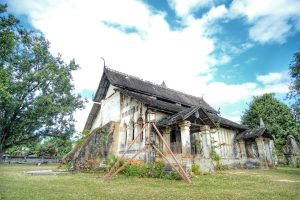
Built around 100 years ago, Taleo Old Temple stands as a haunting reminder of both colonial history and war. Constructed in a French colonial style, it survived intense U.S. bombings during the Vietnam War because Vietnamese soldiers were stationed here.
Today, the temple’s roof is damaged and propped up by wooden supports, yet its murals and altar remain remarkably preserved. Locals still come here to pray and offer incense, giving the site a quietly spiritual atmosphere amid the crumbling walls.
17 km south of Hotay Pidok Library along a dirt track – best visited in dry weather.
Turtle Lake
Just 5 km south of Taleo Old Temple lies Turtle Lake, a tranquil spot home to the rare Khorat Snail-Eating Turtle. These turtles are considered sacred, and harming them is believed to bring misfortune.
Visitors can buy snacks to feed the turtles, and it’s common to see local children singing traditional songs to attract them to the surface. The lake also has a small shrine at its center, said to protect both the turtles and visitors.
A peaceful and memorable stop for nature lovers – perfect for slow-paced riders.
Wat Phathat Phon
Wat Phathat Phon is one of the most important religious sites in the Savannakhet region. While its exact origins are unknown, it’s believed to date between the 7th and 16th centuries.
The complex includes an elegant main stupa, prayer halls, shrines, and monks’ quarters surrounded by shady trees. It remains an active pilgrimage site for both Lao and Thai Buddhists, especially during annual festivals.
Located 50 km south of Savannakhet – easily combined with the Stone House on your return ride.

The Stone House – Heuan Hinh
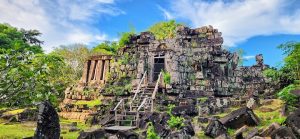
Constructed during the 9th century by the Khmer Empire, Heuan Hinh, or “The Stone House,” once served as a resting house for travelers and pilgrims on their way to larger temple complexes.
Built from massive sandstone blocks fitted together without mortar, the structure has partly collapsed, but its walls and doorways still stand strong after more than 1,000 years. You can walk freely among the ruins – the site remains spiritually significant to locals, with occasional festivals held here.
50 km south of Savannakhet, or 26 km from Wat Phathat Phon. The two sites are often visited together when riding between Pakse and Savannakhet.
Summary
The Xe Champhone Loop might not be as famous as the Pakse/Bolavean or Thakhek Loops, but that’s part of its charm. It’s peaceful, authentic, and packed with hidden treasures – from sacred temples and rare wildlife to ancient libraries and local legends.
If you have just one day, you can visit the highlights, but two days allows for a much richer and more relaxing experience. Whether you’re connecting between Pakse and Thakhek or just exploring the south, this loop offers a slice of authentic Laos that most travelers never see.
Related Routes
The Xe Champhone Loop can be found below with just the Loop map, but also here with our all of Laos map.
.
Reviews
Share your experience and help other ridersNo reviews yet. Be the first to review!
Leave a Comment & Review